Thursday, April 16, 2020

Review: Exodus: Paris Nouveau

Exodus: Nouveau Paris
Players: 4 – 6
Publisher: Indie Boards & Cards
Year: 2018
A copy of this game was distributed by the publisher in exchange for this review.

In a devastated warzone, refugees need to be rescued. As other teams have been compromised, it’s now up to you and your team to help these people. However, the other teams never returned and there’s a strong suspicion that not all of your teammates are rooting for the same team.

Set in the Dystopian Universe, the goal of the game is to rescue as much people as possible, while still evading your pursuers. Every turn a leader is voted for, by blind bidding with a limited number of voting tokens, and that chosen leader picks a Tail-end Charlie. They resolve their actions and a new round starts with voting for a leader.

The loyalty cards
A single round progresses as follows: First of all, a leader is elected. People are free to discuss who they think the leader should be, but the final voting is down to how many voting tokens people are willing to spend. The leader picks a Tail-end Charlie that has to make up the rear of the group. The leader can then be given distance cards, but as this process is slightly randomized, your card might not end up with them at all. Players can submit a card, but only three can be chosen. If there are less than three, cards from the deck are added. To the three chosen cards, another card from the deck is added, shuffled and one discarded. Your card might end up with the leader, but it could have been discarded. From these cards, the leader plays one and resolves their actions. Afterwards, the TEC draws two cards and plays one.

There are several ways the game can end. As soon as a player has no more life tokens left, their side loses. If there are no more cover tokens left, the hunters win automatically. If the hunters overtake the rescuers, because they have more distance tokens, the hunters win again. None of these conditions arise, the game ends after the seventh round and the victory points are calculated. The side with more victory points wins.

The two most exciting positions in this game are the leader and the TEC. The cards determine the victory points, but also the distance between the rescuers and the hunters. Cover can get blown or people can get hurt as a result of the cards played. Every decision you make in these positions affects the other players and the game.

A nice addition is that in this game, everyone can be the enemy. You know that there’s half of the other players are the enemy. The question remains who can you trust? It might be fun to treat all other players as potential enemies, but if a player on your side dies, then your side still loses. On the other hand, if you discover someone’s true loyalty and you manage to eliminate them, you win! It’s tight gamble, but are you willing to risk it? Will you risk alienating other players to achieve victory? It’s an example, but there’s a lot of tension in this game. The player roles are nice, as they can impact on how you play the game. As a broker you have more voting tokens and thus have more influence on the outcome of a round. The negotiator can remove distance tokens, but turn a hunter card facedown. This means it has no distance and is worth no points at the end. Overall, it can sometimes feel like a management game, where you need to control different stats, but only have a limited space of action.

Some of the roles in the game
In this game you have the most influence when you are the leader or the Tail-end Charlie. As such, when you’re neither, you can still hand in a card, or not, but it’s not the same. As the leader doesn’t pass, but gets voted for, it can take a bit of finesse to get used to this sort of gameplay. It’s also less easy to teach than the Resistance and can only be played with four to six players. Overall, most of the things discussed above, are subject to the idea of moving away from the lightness of The Resistance and more towards a complex game.

Most outstanding feature?
The best part of this game is that you simply can’t trust anyone, but don’t want them to die either. The game walks a fine line between being suspicious and being paranoid. It’s only after the game that you’re certain of anyone’s loyalty!

Overall, this game is another hit from Indie Boards and Cards. While it might not be as simple as the Resistance or Coup G:54, it’s certainly worth a try if you’re looking to spice up your social deduction games. I can certainly recommend it! 


Wednesday, April 1, 2020

Review: Senators

Senators
Players: 3-5
Publisher: Indie Boards & Cards
Year: 2017
A copy of this game was distributed by the publisher in exchange for this review.
Rikki Tahta, known of Coup and Coup G:54, is a well-known designer of boardgames. While his other games feature attempting to seize powers in a futuristic setting, the theme this time is the civil-war ridden Roman republic. Instead of attempting to eliminate their opponents, the players attempt to fight over the favor of the senators and try to sway them to their side. As in the Coup and Coup G:54, money is used in order to do this, because the senators can be bought.

The different resources and the coins used in the game.
The goal of the game is to acquire the support of as much senators as possible. This is done by buying their support directly or by using other means. The player can trade resources for their support, try to extort resources from other players or auction common resources. As the game is of an uncertain length, it becomes race to get ahead of the other players and stay there. At the same time, players will try everything to reduce the power of others. Expect little mercy in this game.

On a player’s turn, there are a few options available. They can start an auction, where a three resource cards, and an office card are turned over. People can then bid on these individual cards and the starting player has the option of accepting their offers or buy them from them at the mentioned price. Any cards not bid on are acquired for free. A player can also extort a card from another player, where a player mentions a price and the extorted person can either pay up or accept the mentioned price. Lastly, a player can also cash-in. This means they turn in their resources in order to acquire senators. Another player can also join in on this by paying a set amount of points. The benefit of this is that you wouldn’t lose your turn and can still take another action.

Because the auctions can work two ways, it’s a bit tricky to use. You can drive up the price for the other player if they desperately want to have a certain card, but if you’re not careful, you drive up the price too much and need to pay for it yourself. It’s not just plunging into an auction and burning as much bridges as possible for everyone, but calculating carefully about every option available, which can change rapidly due to the changing circumstances. 


The different governors.

The auction and bidding system is really good. It provides a fresh and interesting twist to a familiar game. The artwork, as often with Indie Boards & Cards, is well done! There is player elimination, but it’s highly unlikely that this will happen. I see this as a major benefit, because player elimination in long games is a drawback for me.

This game might not be suited for all crowds. While you can plan, prioritize and act accordingly, luck is a major factor in the game. We had one game where it was all over within 7 turns. Luckily others last much longer. However, this randomness will not appeal to everyone. There’s blind bidding, people their money is hidden behind player screens. Also the player screens mean it’s less travel-friendly than some other games.

Most outstanding feature?
I’d say the mechanic of the event deck. This elevates the game to a higher level, as the game can end possible with the next player or maybe a couple of turns after it. As such the player doesn’t just need to be ahead at the end of the game, but because you don’t know when this happens, you need to try to be ahead all the time.

Overall, I’m stunned by how well all the mechanics incorporate in this game. Rikki Tahta, of the games mentioned earlier, delivers another great game. Compared to those games, the portability of Coup and Coup G:54, its mechanics feel familiar, but its different enough that both can be owned separately. If the mechanics appeal to you, or social games interest you, then I would certainly recommend this game!

Wednesday, March 25, 2020

Review: Among Thieves

Among Thieves
Players: 3-8
Publisher: Indie Boards & Cards
Year: 2019
A copy of this game was distributed by the publisher in exchange for this review.

Among thieves is another game set in the Dystopian universe, where players try to rob three different corporations. However, the corporations aren’t the only ones that money gets taken from, as players can also take a disproportionate part of the loot. What follows is a rough game of stealing, plundering, backstabbing and betrayal.

This game revolves around extorting money from big corporations. The goal of the game is to get as much money as possible from these powerful businesses. And if you’re at it, why not take it from your other players as well? Every turn a heist is performed and the gained money handed out. The person that decided who joins and who doesn’t, moves from player to player and as the game progresses the payout becomes larger and larger. Of course, more money on the table, also means that people are more likely to choose for their personal interests.

On a turn, the heistmaster creates a team for the heist. You want to be on the heist, because only then you can participate in the payout. However, promises are not binding, so be wary. As soon as a team is formed, a corporation is robbed. This can be one of the three corporations. The players on the heist then decide whether to be honorable or dishonorable. There are only two options in this case. Based upon the actions of the players, various things can happen. Events are resolved if they come up and the reward is handed out. Lastly, honor is gained and/or lost. The honorable players gain one honor and the dishonorable players lose one.

Cards that determine the payout.
The payout is determined by how many players were honorable. For every honorable player a card for the payout is drawn and their value is added to the total. Two honorable players means two cards for the payout, while three honorable players means three cards for the payout. I mentioned it briefly earlier, but the payout of the heist also depends on the actions of the players. If everyone is honorable, the players collect credits equal to the payout. If there was at least one dishonorable player, but not everyone, the dishonorable players gain credits equal to double the payout. They may also draw a card from the corporation that they robbed and place this behind their screen. They don’t contribute to the payout, but these cards can be beneficial at the end of the game, when determining final honor. The payout is still determined by the sum of cards for the honorable players, although the honorable players gain nothing. If everyone was dishonorable, no one gains anything.

The game can end in several ways. If a pile from one of the corporations runs out, the game ends after that turn. The player with the least honor is eliminated and the remaining player with the most money wins! However, in the three corporation decks there are three Game End cards. These are in the bottom third, but can be shuffled through the deck for a shorter game. The Corvid ending eliminates the player with the most and the player with the least honor. The remaining player with the most money wins. The Paragon ending eliminates the player with the least money and the most honorable player wins. The Le Fleur ending eliminates no players and the player with the most money wins.
A Game End card and two Event cards.
As the player screens hide the money, but not their honor, you have some information, but not everything. You don’t know how much money is hidden behind their screen, although you can make an estimate, and you don’t know how their hidden cards affect the ending of the game. I like it as you have some concrete information to work with. You have a rough estimate as how the game is progressing and you have an idea of which ending is more likely to trigger. You can act accordingly, but your plans might still be ruined by luck of the draw.

This game keeps everyone involved in the game. There’s no player elimination and as the payout increases, players have a decent chance of recovery. Two lucky heists can have people really bounce back. As such, everyone really plays until the end. Also, the top player has no immediate benefit, which is good.

This game depends a lot on how other people play. If they all play as honorable and no one tries to take anything from another, the game doesn’t really shine. The same happens if everyone is dishonorable all the time. Promises are not binding, so not all players might appreciate this sort of game. The artwork has been used in earlier games set in the Dystopian universe, such as Coup G:54 or the Resistance. While not immediately bad thing, it’s a something that we noticed.  On the other hand, new artwork might have made the game more expensive.
A comparison of the banker in Coup and that same banker in Among Thieves
Most outstanding feature?
I’d say the honor track. The addition of this in the game is nice, because now people can’t just betray everyone every turn, as then that would mean their end rather fast. Instead, there are several things that people need to keep an eye on. As it’s uncertain which ending is going to be resolved and which ending is more likely to happen, you don’t merely want just money, but also honor. As you don’t know how much honor all other players will have at the end of the game, due to the hidden cards, it’s sometimes better to be honorable rather than acquire the most money. The different, and uncertain, endings are a great addition to the game that really let this mechanic shine.
  
Overall, if some of the aspects described above, please don’t play this game. If betrayal games are not your cup of tea, you will not enjoy this game. Players try to be as mean as possible and cheat each other as much as possible. However, if this does appeal to you, then certainly give it a try. It’s a great game and you’ll have a lot of fun backstabbing (or not!) your friends!

Friday, March 20, 2020

Review: War of the Worlds: France

War of the Worlds: France
Player: 1
Publisher: Dan Verssen Games
Year: 2018
A copy of this game was supplied by the publisher for the purpose of this review.

H. G. Wells War of the Worlds is a classic in fiction. It inspired many movies, series, board- and videogames. DVG’s The War of the Worlds places the invasion of the martians on a global level and allows the player to take control at a tactical and strategical level. As earth is being invaded, you need to organize the human defenses and beat back the martian invaders. However, instead of invading the United Kingdom, the martians attack France!

Everything was peaceful in France, before the martian nation invasion attacked!
There are several ways the game can end: A Martian or Human victory based upon victory points, a Human Germ win or a Martian Colonization win. The Martians can gain points for capturing people, refugees and military units, or by devastating the country. If they acquire enough points, they can colonize France and win. The Humans can gain points by evacuating refugees or by starting production. If they have enough points, the humans win based upon biological warfare. Of course, the Martians can also win if they assemble their flying saucer or if Paris is destroyed.

The player’s turn consist of the production phase, where soldiers, ports or other things can be acquired or moved. Infantry, which costs 6 points, is cheaper than siege guns, which costs 16 points. The infantry however can’t destroy Tripods in a battle, but the siege guns can obliterate them. Based upon the still working factories you gain a certain number of points to use. However, infantry can be captured, which gives victory points to the martians, unlike the siege guns.
               Next is the battle phase, where all the battles are resolved, but only on land. Battles continue until either side is wiped out. The danger in battles is that units can be captured, which would mean extra victory points for the martians.
               Afterwards in the devastation phase, the martians wreak havoc. This can range from the loss of workers to refugees fleeing from the martian advance. The loss of workers means trouble for the production later on and they can’t be replaced easily.
               After this has been resolved, there’s the human action phase. Different actions can be taken here, such as moving units or refugees. This if followed by the escape phase, where naval battles are resolved. This is also fought until one side is wiped out.
               Up next are the martians, who receive reinforcements at set intervals and can perform different actions, based upon what the humans are doing. For example, they can work on their flying machine, which would mean a martian victory if the four parts are built. At the end of the martian turn, their points are counted. The of the countryside that has been laid to waste, the more points they get for their colonization victory. In the assembly phase, the martians can receive additional machines, which help them get more tripods later on.
The tripods. Left one used for sea battles, the right is used for land battles.
Interesting is that the battles on land or on the sea are fought differently. The naval battles are about securing safe passage for the freighters with refugees. As long as they aren’t captured by the martians, it can be considered a victory, even if all of your warships are destroyed in the process. The battles on land are much more aggressive and about annihilating the opponent. In order to achieve this various tools are at your disposal. They battles feel like mini-games within a larger game and can be highly entertaining.
              
The same tripods, but damaged. 
It blends elements of tactical skirmishes and strategical games very well! Generally the die has three outcomes: green, yellow, red, which can have different meanings depending on the context in which they are used. Three sides are green, two yellow and one red. The mix of both the strategic battles and the tactical conflict is really interesting.
               While a benefit, it also has a downside. The Martian-AI is relatively simple. Of course, it could have been interesting to have the option to play as the martians, actively trying to colonize Earth, but that would be a whole different game. Of course, it would be impossible to blend both elements together in the same box. 
               Sometimes it feels a bit awkward to have the battles reduced to such a roll of the die. Also units can’t be retreated. So warships that survived the battle can’t be used in another battle. This is a bit of a gamble sometimes, as certain battles are almost an immediate loss and the forces could better be used elsewhere.

Most outstanding feature?
I would say the battle maps as well as the many counters. As such, the game combines elements of wargames, and miniature games. The battles aren’t only fought on the battlefield, where the player resolves combat between the humans and the martians, but also on a national scale. In this case it’s France, but it could also have been the US, the UK or Japan.
               The nice part of it is that it forces you to think on a tactical level, what works on the battlefield and how do you destroy the enemy, while also keeping an eye on the strategy, what creates the most beneficial situation for your soldiers and ships? You aren’t merely focused on destroying the enemy, but how to achieve victory in the long run. In order to achieve that it might be beneficial to sacrifice a few units in order to set up a trap, which destroys the martian attacks.

Overall the game fits in the niche between miniature wargaming and boardgames. It allows player from either side to experience the themes with which they are familiar, while also adding elements from the other side to it. It fits in here very well! There’s plenty of counters and tokens to go around. The game is more complex than some boardgames, but light enough to be enjoyable and swift. 

Tuesday, February 25, 2020

Review: Life is Life

Life is life
Players: 3 – 5
Publisher: White Goblin Games
Year: 2016

Life is precious and as the ship is sinking, limited spaces are available on the lifeboats. As everyone wants to save themselves, it’s a mad dash to safety.

The cat and the sheep.
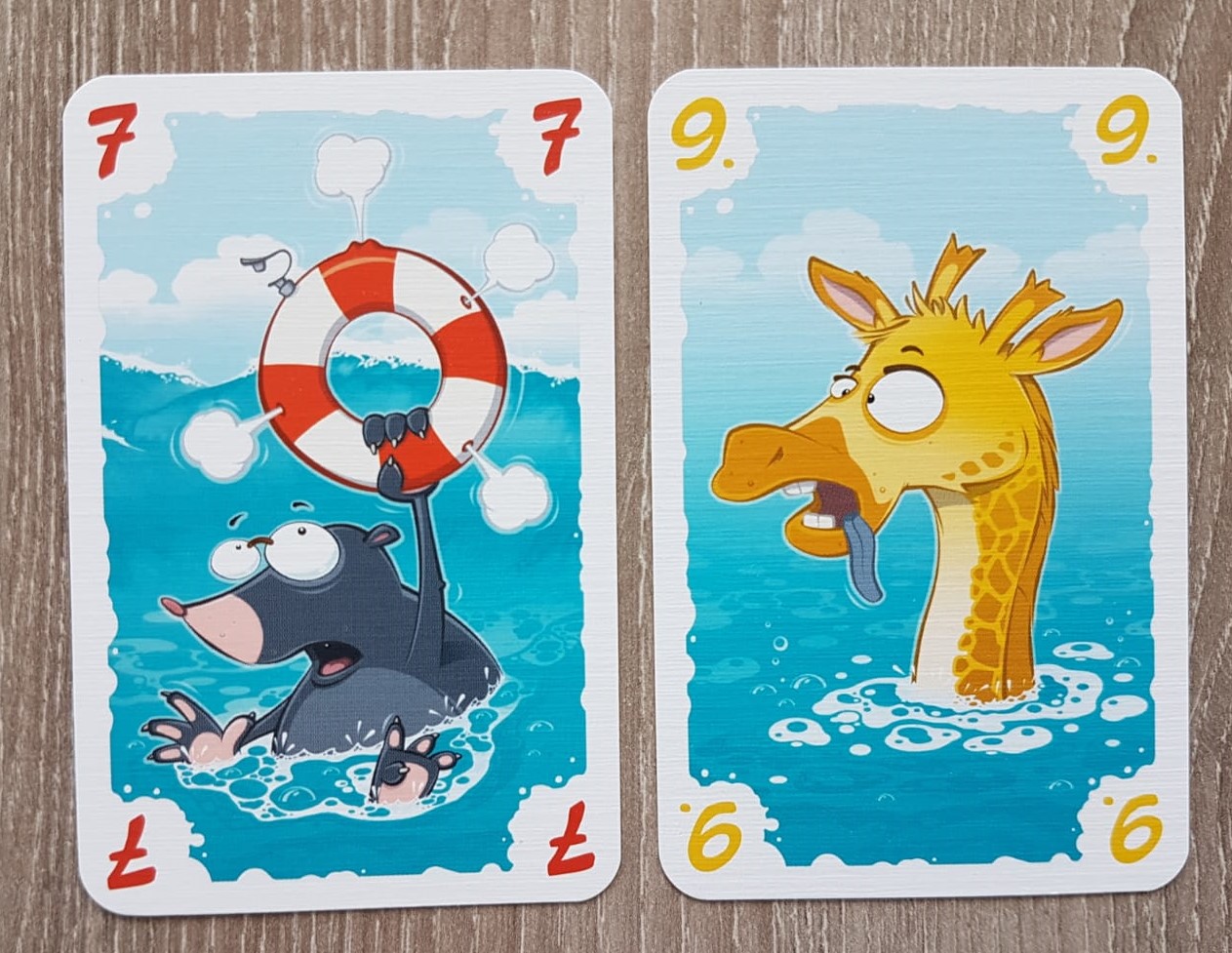
 The aim of this game is to acquire as much points as possible. This can be accomplished by getting the majority of any kind of animal in play. Different animals are worth different points. If you have the most mice, you gain 3 points, but if you have the most giraffes you get 9 points. The points also indicate how many cards of a type are available. So in the case of the mouse, there’s 3, but in the case of the giraffe, there’s 9.

The game consists of 60 cards and each player is given 10 cards, as well as 5 lives. In the middle of the table there is a row with 1 – 2 – 3 – 4 cards. Each turn, a player can swap his or her cards with the row in the middle, after which the next player takes their turn. So if you decide to take the row of 2 cards, you also need to replace them with 2 of your own cards. If you decide to trade with the row of 4, you also need to replace them with 4 of your own cards.

A player can also knock, to signal the end of the round and all other players take one more turn and the points are tallied. Whoever has the majority of a certain type of animal, wins the mentioned points. The player with the most points loses no lives, the player with the least points loses two lives and those in between lose one life. The game continues until there’s one winner left.
The mole and the giraffe.
Alternatively, a player can collect all the five pigs, five rabbits or the four cats in order to force an immediate end to the round, where all other players lose a life. As soon as this is resolves, the cards are shuffled and a new round starts.

The game is fun, fast and easy to play. It’s portable and the artwork makes it suitable for a younger audience as well. You need a bit of luck, but that adds to the flair of the game. Of course, the size also comes with a disadvantage, as the game isn’t complex and might not be as challenging as some other games. Then again, with the younger audience kept in mind, it’s justified.  

Most outstanding feature?
While it’s a light and simple cardgame, the bright artwork really helps. The unfortunate animals are adorable and add some comical relief to this game. Overall, I can certainly recommend this game!

Tuesday, January 21, 2020

Review: One Night Revolution

One Night Revolution
Players: 3 – 10
Publisher: Indie Boards & Cards
Year: 2015
A copy of this game was distributed by the publisher in exchange for this review

The Dystopian Universe is large and in turmoil. As always, this opens opportunities for different factions as well, as they try to seize the means of production, err, power. In this game, the struggle is boiled down to a single one night revolution.
 
Two ID cards, a rebel and an informant
The goal of the game is for the rebels to identify a singly informant. There are rebels and informants, basically the resistance and the spies from the Resistance, and the informants win if they remain hidden. To help with this, there are specialists, which are special roles that players can use to acquire more information. 
               At the beginning of the game, everyone closes their eyes, and the informants get to know one another. Afterwards, beginning with the starting player, clockwise everyone performs a certain action during the night-phase. After the night-phase, during the day, all players take a specialist token, based upon the action that they claim to have performed, debate about the information they have and eventually cast a vote. If an informant is correctly identified, the rebels win, but if a rebel is picked, the informants win.

The headquarters, where three random ID's are placed.
The night action is interesting, as various things can happen, including re-assigning your loyalty. There’s a specialist/role that allows you to swap to people’s IDs, while another one allows you to reveal a person’s ID. This gives the information used in the debate during the day. These actions can also change depending upon your personal loyalty.
               The debate, is short and fueled by the role that everyone claims to have. Eventually the starting player counts down and a vote is cast. If the vote singled out an informant, the rebels win, or vice versa. There’s some information to go on, but it takes a bit of expertise in order to successfully conceal your role. You need to be familiar with the rules and the specialist actions in order to hide or grasp what is going on.

The components are superb quality. The ID cards are small tiles and very sturdy! The only thing that could have been better would be the reference cards, as they are a bit flimsy. The artwork is good and familiar to people that played the Resistance.

While there is concrete information to go on, things have an unexpected twist due to the abilities. People might know more than they are willing to share, but then again, they might also not be who they think they are! It’s a bit of a bummer if you think you’re one side and suddenly discover you’re another. A fun twist is that the amount of informants is unknown, which can range from 0 – 3, depending on the group. Unlike the Resistance you don’t know how many enemies there are and it adds extra paranoia! There are always three more ID's in the game than players and they are placed in the Headquarters. Another benefit is that this game goes quick, so another round can easily be started or if there's limited time.

Most outstanding feature?
I’d say that the components are great! They are sturdy, nicely-finished, and informative. Indie Boards & Cards often has high quality components and they again meet their own standards.

Overall, this game contains elements that appeal to me and others that I’m not such a fan of. I’m a huge fan of social deduction games and this game fits in a familiar spot. I like that the information is pushed forward and that the game is fast. However, I’m not a huge fan of the concept of swapping sides or that it’s so hard to hide. As an informant you need to know the rules and be familiar with them in order to not be revealed. There’s a steep learning curve. However, once you grasp it, you can certainly have a great game.

Tuesday, January 14, 2020

Review: Veteran and Dog, an expansion of Flash Point: Fire Rescue


Veteran and dog, expansion of Flashpoint: Fire Rescue
Players: 2 – 6
Publisher: Indie Boards & Cards
Year: 2013
A copy of this expansion was made available by the publisher in exchange for this review.

On this blog, we’ve reviewed Flash Point Fire Rescue in the past and it’s a great game. For the continuation of this review, we assume you’re familiar with the game Fire Rescue. If not, check it out here. It was one of the first reviews on this blog!

The dog and the veteran

Another one of the expansions from Flash Point: Fire Rescue and it features two additional roles, a role card, and twp miniatures. These roles can be selected at the beginning of the game or if people wish to change crewmembers later. The new roles add more diversity, as each character brings a unique skillset to the game. And you can now play as a non-human companion!

The veteran has 4 AP per turn and has the ability to dodge explosions. He doesn’t just grant himself this boost, but also affects the other characters around him. The other characters can benefit from his experience, as they have an additional Action Point to spend. As a result, the gameplay changes, and people tend to move and work more as a team, in order to receive the extra point. As some characters have 3 or 4 AP to spend every turn, they benefit more from this than characters that have more AP to spend every turn.

The dog is the most unique character in the game so far. The dog has 12 AP and can save up to 6 of them per turn. The dog moves as a normal character, but can also reveal POI in adjacent spaces, drag people (for 4 AP) or squeeze through damaged walls if no victim is dragged along. However, these are also the only actions a dog can take. For example, the dog cannot drive the vehicles or chop walls. So the dog is used only for saving victims, but has a huge energy boost in order to do so. The 12 AP is a lot and can navigate most of the map in a single turn. Even moving victims goes faster than with a regular character. The dog is geared towards a certain task and does that extremely well. And everyone loves to play as the dog!

The dog is most unique in their skillset compared to the other characters released so far. The veteran is most unique in terms of gameplay, as he alters the way other characters interact and behave as the game progresses. It’s a small expansion, and adds only characters to the game. It increases the replay ability of the game, although not as much as one of the maps expansions. If you’re looking for additional roles, or miniatures, for the game, then certainly consider this expansion.

Tuesday, January 7, 2020

Review: Urban Structures, expansion of Flashpoint: Fire Rescue


Urban Structures, expansion of Flashpoint: Fire Rescue
Players: 2 – 6
Publisher: Indie Boards & Cards
Year: 2011
A copy of this expansion was made available by the publisher for the purpose of this review.

On this blog, we’ve reviewed Flash Point Fire Rescue in the past and it’s a great game. For the continuation of this review, we assume you’re familiar with the game Fire Rescue. If not, check it out here.

Urban Structures was one of the first (of many!) expansions released for Flash Point: Fire Rescue. It features a new role, two new maps and new rules. I’ll examine them all in detail and how they change the flow of the game.

The new role that has been added to the game is the structural engineer, who can repair the house. The primary reason people lose this game, is because they run out of cubes to put on the board. This indicates that the house has taken too much damage and has collapsed. Now you have the possibility to repair the house, or remove hotspots, while trying to rescue people. The downside is that this character can’t extinguish fire. This character isn’t chosen a lot in smaller groups, as we need everyone to help, but in larger groups he’s often present as allows the other players to stay longer in the house. While not the best character, he prolongs the time that the groups have before the house collapses.
 
The apartments, note the dividing wall in the middle.
The apartments is one of the two maps that comes with this expansion. It represents two buildings in a row, which can only be assessed from the front or back, but not from the sides. The main twist of the game is that the map is divided in half and you either need to move around it, or create another opening to move through. Since you can’t easily get from one side to another you need to think ahead and move accordingly. Personally, this is one of my favorite maps and a great way to look for a new challenge.

The office building is another map, printed on the other side of the board. It’s supposed to be an office above ground level, and includes flimsy walls that are destroyed with a single cube. Other walls still need two cubes in order to allow someone to safely move through. Instead of dragging the people outside, they need to be evacuated through the elevator or with the help of the fire truck. Entering is a bit more difficult, as people leave and enter through the elevator, or use the ladder from the fire truck. The structural engineer is a great addition here. On this board there’s light wall, shaded in a different color, that collapse more easily. A few bad explosions can really eat up a lot of the damage counters and thus might need to be addressed. At least with the structural engineer you can reverse some of the damage. 

Overall, this expansion strikes a fine balance, but they’ve managed to achieve it. Gameplay isn’t really changed, but it provides more of a similar taste. The variety in maps, while also having an additional role, is nice and breathes new life in a game that can feel bland after repeated plays. If you wish to drastically alter your gameplay, you might look for another expansion, such as tragic events. In other words, this expansion adds more of the base-game to your game, while keeping the game the same. 


Wednesday, December 18, 2019

Review: Grifters: Nexus


Grifters Nexus
Publisher: Indie Boards & Cards

Players: 2 – 4
Year: 2018
A copy of this game was distributed by the publisher in exchange for this review.

Recently I’ve reviewed Grifters here and I’ll briefly summarize a few aspects of that game in order to give the reader a general idea of the game. After that, I’ll continue with the difference between this game and Grifters.

In this game you’re also a crimelord and your task is to acquire as much points or coins as possible. This can be done by stealing them from the general pile, other players or by completing jobs. For these jobs to succeed a certain combination of skills is needed, such as a brain-person, a brawn-person or a speed-person. Instead of having a ‘wild’-card specialist, that could be any color, there are now jobs that can take any color when the game is over. The game ends when there are no new gangmembers to recruit, no new jobs to complete or no more money to steal.

Various specialists.
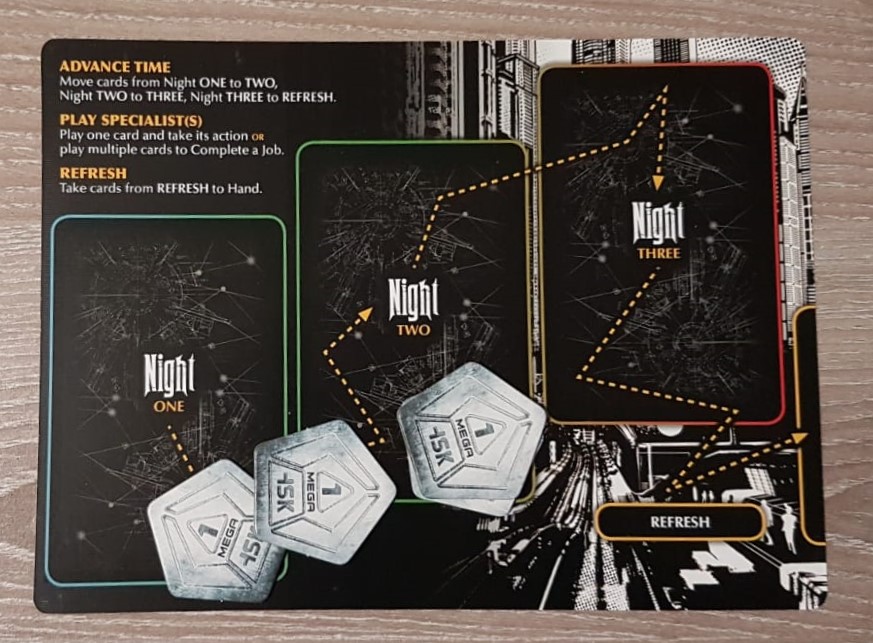
At the start of the game three specific gangleaders and three random cards are given. Cards still cycle through the ‘three nights’ system as before. This means that after you have played them, they can’t be used for three turns and then go back in your hand.

Now the main difference between this game and regular Grifters is in the set-up and the ‘Laundering’ mechanic. Laundering money doesn’t give you the coins, but instead just removes them from the game. In other words, the general pile is reduced by a small amount every time a card uses this ability. 
Various jobs, including wildcards.
Another new thing is the different set-up. The jobs are now stacked in the form of a pyramid, where jobs can only be completed if lower ranking jobs are already cleared. As in regular Grifters, at the end of the game, the more you have of a certain card type, the more bonus points you get. Also there are several ‘wild’ jobs, that can go into any category and are a lot more valuable. However, all the jobs now need a leader and the reward is always the same: only the action of the leader.

So after a few plays, and comparing it with regular Grifters, a few things stood out. First of all, the launder mechanic wasn’t hugely popular. Reducing the general pile is indeed a possibility, but since the money just disappears, it’s less attractive than stealing coins from another player or from the general pile. In that case you at least benefit from your action, in the other case you don’t.
               In regular Grifters people wanted to complete jobs as soon as possible, either for the reward or to use it at the end of the game for a bonus. In this game, people generally preferred to use their single specialists, as there was no benefit for sending a team out somewhere. Jobs became more of an afterthought, as you might want a specific job, for the end-game bonus, or because you had a certain combination, but another job was blocking it. You could send your good specialists on a certain task, but then they wouldn’t be available to use for a job, which could then be completed by another player.
               As a result, the flow of the game is different. Whereas in Grifters people were aggressive, pursuing the jobs, and actively trying to interfere with each other. Grifters: Nexus is more hesitant and jobs aren’t completed as often as they could be. Of course there are also flaws in Grifters, but they are negated or forgiven, as the game is light, easy and fun. In Grifters: Nexus, because of these changes, it feels as it overstays its welcome. It felt a bit as if an annoying acquaintance comes over for an afternoon and then suddenly decides to spend the night at your place.

Most outstanding feature?
The ‘three night’ cycle system, where cards return to your hand after three turns. Also, the artwork is stunning, just like in the other game.

To compare the two games: I’d recommend Grifters over Grifters: Nexus. It’s easier and a lot more fun. However, if you’re looking for more of a challenge or think Grifters was too simple, then try Grifters Nexus.  


Tuesday, December 10, 2019

Review: Grifters

Grifters
Publisher: Indie Boards & Cards
Players: 2 – 4
Year: 2015
A copy of this game was distributed by the publisher for this review.

As the Dystopian Universe expands, different groups emerge. There are people that wish to overthrow the oppressing government, others might want to keep the system as it is, and now a third group emerges that’s indifferent to who’s in charge, as long as they got the most money. In this game you play as one of the latter and your job is to have the most money/points by the end of the game.
A selection of characters, with a speed, a brain and a brawn card.
You’re a crime lord and in this game you collect currency, labelled 1M ISK, as we’ve seen in other games by the same publisher. You do this by stealing from the coffers (the general pile) or stealing from other players or by completing various jobs. To do these jobs you need thugs or other henchmen to do your work. These are available in three groups: brain, brawn and speed. In general, brain allow you to recruit additional gang members, brawn allow you to steal from other players, while speed steals from the coffers. To complete a job a certain combination of cards needs to be played. This can be three brain cards and a speed card, or more, in the case of higher ranking jobs. If the henchmen are sent out on a job, their ability is not used, but instead the reward from the job is given. The game ends when there are no new gang members to recruit, no new jobs to complete or no more money to steal. Every 1M ISK you have is worth one point and additional points can be gained if several jobs of the same type have been completed. In my experience the jobs run out, before another of the endgame condition triggers.

The player board and a few 1M tokens on it.
The starting hand consists of three gang members, one of each color, and three random cards. There are certain cards that are highly situational, while others are always useful. To complete a job, a team is created, based upon the requirements of the task at hand. If these are met, the job is completed. Of course, it’s also possible to play a single criminal, which can do various things. Once a card is played, it’s inaccessible for three turns (or ‘nights’ as the game calls it). After it, the cards end up in your hand again. This is interesting, as it gives you a lot of information. You know where your people are and you also know where the opponent’s cards are. As such there’s a lot of information going around.

The game manages to hit a sweetspot across various gamer groups. It appeals to those that are interested in games, but don’t play a lot. People that are dedicated gamers will also like it. There are various winning conditions and based upon the group, you can decide to play for one or the other. It’s really well-done. You can teach it quite fast and after showing one full cycle once, most people will get the idea of the game. It’s great as introduction game or as something to bring along on game-night. 

A downside is that it can be a bit shallow after repeated plays. However, that’s part of the game. To make it more complex, would’ve meant that it would put off more casual gamers, family members, or people that aren't really into board/card games. It also isn’t a huge loss, as more casual gamers are usually fine with doing something else after two or three plays.

Most outstanding feature?
There are several close contenders. The interesting deck-cycling mechanic, the artwork and the fact that it seems to fit with a lot of groups. I’d choose the latter as this game can be played with a diverse crowd and all will enjoy it. Another nice touch is that the game-length seems to be perfect, at around 30 minutes it neither overstays is welcome or is it too short to be shallow. Do you wish to end the game as fast as possible? Go for the jobs. Do you want to reap as many profits as possible, keep stealing from your opponents.

Overall, there are great mechanics in the game, it's light, easy and a lot of fun! It's great for social gatherings or similar events. As the length of the game can easily be tweaked, it never overstays it's welcome.

Tuesday, December 3, 2019

Review: Avalon


The Resistance: Avalon
Players: 5-10
Year: 2012
Publisher: Indie Boards & Cards

A copy of this game was distributed by the publisher for the purpose of this review. Another note: From here on Avalon will refer to The Resistance: Avalon, while the Resistance will refer to board game The Resistance, which has been reviewed on this blog before. I must also admit, that I’m slightly in favor of the Resistance over Avalon.


Generic roles
Many reviewers have written about both the Resistance and about Avalon. Avalon is a stand-alone game from the same company, which features aspects of the Resistance and adds an Arthurian theme to it. Instead of fighting against an oppressive government, the players are knights in service of Good (Arthur) or Evil (Mordred). The idea is the same, that through 5 quests, one side overcomes the other.
For these quests teams are selected and there’s a vote to approve or reject the team. If the team is approved, it’s sent out to fulfill the quest, where the participants can play for the success or failure of the quest.  As soon as one side wins the majority of the quests, the game is over.

What’s nice about this box, is that it features everything in order to play the basic game of Resistance, as well as several extra’s. Included is for example a few roles, such as Merlin or Morgana, who have certain knowledge that others don’t have. Another example is the Lady of the Lake, which allows a player to determine the loyalty of other players.
Special roles
Difference between Resistance (2nd) and Avalon.
The main difference is of course that a few roles have been added already. As such Avalon is a stand-alone game, which also has a few additional elements to enrich your experience. While the Resistance has several dedicated expansions with unique elements, Avalon can stand firm on it’s own, providing both the base game of the Resistance as well as parts of the expansions. It also provides a cheaper alternative to players that want the Resistance and a few extra’s, but without the additional costs of the expansions.
A slight downside is that the new roles are nearly all catered around ‘Merlin’, who knows who all the evil players are. However, he also comes with the ‘victory’-condition that not only does his side need to win, but also do the Evil players need to guess wrong. If the Good side won, but the Evil side guess correct who’s Merlin, the Evil side still wins. Therefore if people wish to incorporate roles, they need to start with Merlin and go from there.
Storytelling is also different in Avalon. While in the Resistance, a lot of things are unnamed and open for interpretation according to different settings and themes, this is slightly more difficult in Avalon in my personal experience. There’s only a setting, while with the Resistance it was easier to change it. Usually we come up with our own missions and narrate them accordingly. This is works a little bit different in Avalon, which doesn't have to be a bad thing.  

Most outstanding feature?
The most outstanding feature in this game is the blending of the theme with the artwork. Everything fits together nicely and the cards look gorgeous. I would highly recommend it.

Post-game reflection
I remember at the beginning that I was strongly in favor of the Resistance versus Avalon. Now that I've played it a few times, I must admit I've mellowed my opinion. The gameplay is largely similar and the difference is largely in theme only. Although I'm still slightly in favor of the Resistance due to personal experiences, both games are great. 

In short: The biggest difference is in theme, between a sci-fi setting or a medieval/fantasy setting. The Resistance has a lot of room for potential expansions, which add different things to the game at a price. However, if you only want the base game and a few extra’s this stand-alone is perfect! Public opinion is also in favor of Avalon and it certainly is a worthy addition to every collection.

Monday, November 18, 2019

Review: Czas Honoru


Czas Honoru Dystopian Game Reviews
Players: 2
Publisher: Phalanx
Year: 2013

In 1944, in German-occupied Poland testing was done for the V-2 missiles, Hitler’s latest secret weapon. As they were being tested, and the missiles crashed, fragments were being collected with the purpose of being sent to London for further examination. In this game the Polish underground forces are pitted against the Germans.

The home-zones
Setting up is easy, as both players take a deck and the zone cards are placed between them. Cards are divided along various units, such as regular soldiers/partisans, or elite units as the SS/Silent and Unseen. Cards start in their Home Zone. Based upon how they are positioned, they can perform an action or not.

A turn consists of several phases. Players draw their cards and rocket fragments are placed. Afterterwards players take their actions, which continues until both players pass after each other, does the turn end and is a new turn started. This is repeated four times. Afterwards, the victory conditions are checked. The player that has the most rocket fragments (cubes) after four missiles have been launched (rounds played) is declared the winner. If the players have an equal number of cubes, the German player wins. If at any stage, your Home Zone is invaded and you have no friendly forces to fight them, you automatically lose the game.


Two player cards
The game is a bit simple and plays fast. There are special cards for every deck. It’s interesting how the historical past has been implemented. The cards are language-independent, using only symbols to provide information, although this might be a bit complicated at times. Not all symbols are as self-explanatory as might have been expected.

A downside is that the game can only be played with two people. So if you have a larger crowd, it’s unsuitable. It also has a few nationalistic tones. For example it feels as if the Polish are more powerful than they might have been. However, I’m not an historian, so I don’t know.

The rockets and their fragments
This game's most outstanding feature?
Thematically, it’s a niche game, which is great! It’s an unknown aspect of the Second World War and that alone makes it interesting. It’s wonderful tosee how they have incorporated historical features. The Polish can protect their fragments with Operation Wildhorn III, while the Germans can perform operation Sturmwind, which was an anti-partisan operation. Another example is how the Polish player always starts with the player actions.

There are several interesting mechanics and features. The theme is really cool, but there are also a few flaws in the game. Overall, it’s an above-average game, carried strongly by the theme. If you’re interested in the history, you can certainly get this game.

Monday, November 11, 2019

Review: 1500 expansion: The Netherlands


This review assumes that the reader is familiar with the boardgame 1500: The New World by Dan Verssen Games. If not, you can read about it here.
As this review will look at two of the expansions for the 1500: The New World, there can be overlap between the individual reviews. The first part will explain how AI works, which can be skipped if the other review is also read, the second features the Dutch deck. 

A copy of this expansion was provided by the publisher for the purpose of this review.


The backs of the Netherlands AI and player deck
In general:
The set gives everything necessary to play as a specific country during this historical time period. Included are 56 cards for a player deck, 56 cards for an AI deck and rules to incorporate AI-decks. The deck allows the player to include an extra artificial player to the game. So instead of having just two players, they can be boosted by an artificial one. This means that the player and the AI can play as the same nation at the same time.
The deck includes unique cards and a special mix of cards, as you no longer draw from the same deck as other players. The AI cards are marked as such, with a special background and ‘AI’ on the front. They are easily identified and separated.
In this boardgame AI always goes last in player order. The AI draws cards as normal, but no one looks at them yet. Instead they are placed in a row and first the cards marked ‘Start’ are played, from left to right. Then the other cards are played, going from left to right again. Cards that can’t be played or would make no sense to play are used to advance the AI along the Royal Support Track or minimizing the Royal Support of the human players. Any remaining cards are used for building or reducing colonies (from the highest scoring player).
Normal rules for losing points for struggling colonies apply to the AI and they are removed afterwards. The AI targets the player with the most points, which could be a human player, or another AI. If the AI is the highest-scoring player, it takes on the player in the second position. If there are equals, the target is randomly decided.
Interesting is that some cards feature a minimum condition, so that for example up to 6 colonies may be struggled, but at least four must be chosen in order to trigger the card’s condition. This is of course to help the flow of the game and ensure that cards are left over for the Royal Support track.
The AI and player deck are almost identical, except for some nation cards. The AI contributes to the game as it allows you to play solo, provide a different challenge and adds to the replay ability of the game.

The Dutch nation-powers in the player and AI deck
Regarding The Netherlands Expansion set:
The Netherlands Expansion features a deck of 56 cards for a human player or 56 cards for an AI deck. In the player deck there are 10 cards devoted to special Dutch powers. These include ‘Late Arrival’, allowing the player to remove one colony in each region and replace them with their own. Another one is ‘Appropriation’, where up to 4 colonies can be replaced with your own if all areas have colonies. The last one is ‘Dutch Antilles’, where if you have a successful spice colony, you can take over the other spice colonies from other players.

The deck is good and features several interesting mechanics. The Dutch Antilles and the Late Arrival cards provide a historical note to the game, although the downside of the Antilles cards is that it only targets spice colonies and not other export products. The appropriation card can be useful, but only if all areas are full. This is not likely to happen early-game, but can be useful later on when the map is full and players are struggling over resources.The cards assume that the player deck is used. Only the Dutch Antilles card works a little different in the AI/Player deck, as can be seen in the image.

Overall, the Dutch expansion provides new mechanisms, through the nation cards as well as a whole new mode of playing, through the AI or through the nations deck. It’s a good expansion that adds to the game and provides a bit of historical background. Does it radically change the game? Not really, it’s more of the same, gearing towards a specific challenge, but with a different (historical) flavor. It will certainly be interesting for people that play a lot of solo games.